
You do it roughly 20,000 times a day without thinking about it. It keeps you alive, it happens automatically, and yet most people are doing it in a way that quietly works against their health. We are talking about breathing, and the way you breathe may be one of the most overlooked factors influencing your mental clarity, your stress levels, your sleep quality, and even your heart health.
The good news is that your breath is one of the few automatic body functions you can consciously control, and that access point gives you a remarkable amount of influence over what is happening inside your body. Let's break down what the science and clinical research are actually telling us.
Breathwork refers to the deliberate, intentional control of your breathing patterns. While it may sound like a modern wellness trend, its roots go back thousands of years through yoga traditions, Tibetan meditation practices, and ancient healing systems that understood the breath as a bridge between the mind and the body.
Today, interest in breathwork has exploded. Searches for the term have increased by more than 3,000% over the last 15 years, and that surge reflects something important. People are looking for accessible, low-cost tools to manage the mounting pressures of modern life, and breathwork is delivering results that researchers are now beginning to measure and document in clinical settings.
What makes breathwork particularly compelling from a functional health perspective is its accessibility. It requires no equipment, no prescription, and no special training to begin exploring. It is available to you at any moment, and its effects on the body can be felt almost immediately.
To understand why breathing matters so much, you first need to understand a fundamental concept about how your nervous system works.
Your autonomic nervous system, the part of your nervous system that runs automatically in the background, operates in two primary states. The first is the sympathetic nervous system, which most people know as the "fight-or-flight" response. When this system is activated, your body releases stress hormones, your heart rate increases, your muscles tense, and your breathing becomes shallow and rapid. This response evolved to protect you from physical danger, and it does that job well.
The second is the parasympathetic nervous system, often called the "rest-and-digest" system. This is the state in which your body recovers, repairs, digests food, regulates immune function, and restores balance. It is the biological foundation of calm.
The problem for many people living in modern society is that the sympathetic system gets activated not just by physical threats, but by work deadlines, financial stress, difficult relationships, and even the constant stimulation of screens and notifications. The body does not always distinguish between a predator and an overflowing inbox. The result is that many people spend far too much time in a low-grade state of physiological stress, without ever fully returning to the parasympathetic state where healing and recovery happen.
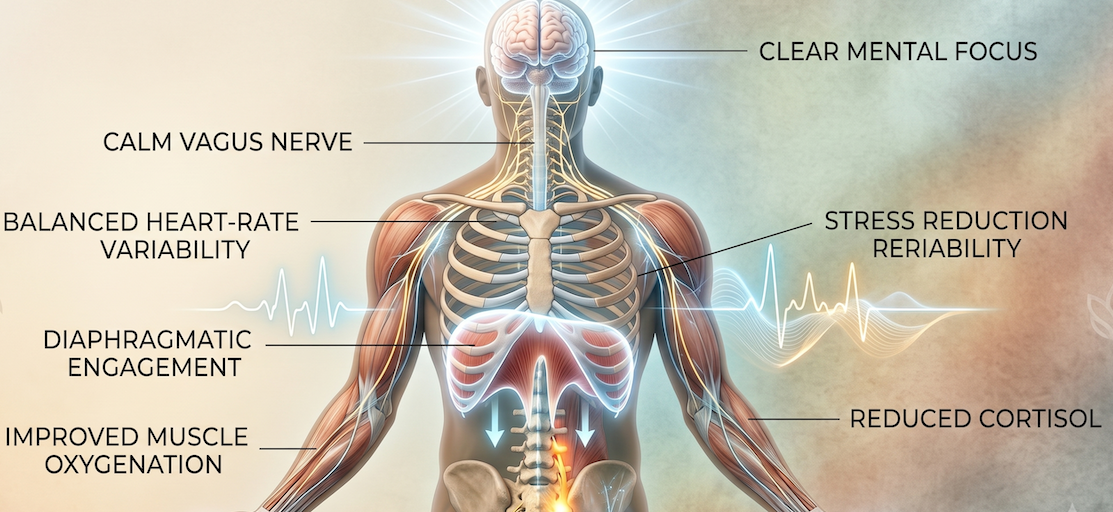
Here is where your breath becomes significant. Breathing is the fastest and most direct way to shift your nervous system from sympathetic activation back toward parasympathetic calm, and the mechanism behind this involves a remarkable structure called the vagus nerve.
The vagus nerve is the longest nerve in the body, running from the brainstem down through the heart, lungs, and digestive organs. It is the primary highway of the parasympathetic nervous system, and its activity level, often referred to as vagal tone, has a profound influence on how well your body handles stress.
When vagal tone is strong, the body can shift out of stress responses more efficiently and return to a state of balance more quickly. Research has connected strong vagal tone to reduced anxiety, lower levels of systemic inflammation, improved mood, and better cognitive function. When vagal tone is low, the body tends to stay stuck in stress mode longer, and the downstream effects on health can be significant.
Slow, deep, diaphragmatic breathing, particularly at a rate of around five to six breaths per minute, is one of the most well-documented ways to stimulate the vagus nerve. This type of breathing triggers the release of acetylcholine, the body's primary calming neurotransmitter, and produces measurable improvements in a marker called heart rate variability.
Heart rate variability, or HRV, refers to the slight variation in time between each heartbeat. This might seem like a technical detail, but it is actually one of the most meaningful indicators of how well your nervous system is functioning.
A healthy heart does not beat like a metronome. It speeds up slightly when you inhale and slows down slightly when you exhale. The greater this variation, the higher your HRV, and the higher your HRV, the more adaptable and resilient your nervous system is considered to be. High HRV is associated with lower anxiety, better stress recovery, and stronger overall cardiovascular health. Low HRV is associated with chronic stress, poor emotional regulation, and a range of health concerns.
Deliberate breathwork, particularly slow and extended exhale breathing, has been shown to improve HRV in a measurable way. From a functional health perspective, this is significant because it suggests that something as simple as changing how you breathe can shift your body toward a more resilient physiological state over time.
The effects of breathwork are not limited to the body. Research using brain imaging has shown that slow, deliberate breathing improves the connection between the amygdala and the medial prefrontal cortex.
The amygdala is the part of the brain responsible for detecting threats and generating fear and reactive responses. The medial prefrontal cortex is involved in rational thinking, emotional regulation, and decision-making. When these two areas communicate well, the rational brain can effectively modulate the reactive brain. When stress is high and breathing is shallow and rapid, this communication breaks down, and people tend to feel more overwhelmed, more reactive, and less able to think clearly.
Slow breathing essentially helps restore this communication. It is one of the reasons why people often report feeling not just calmer after breathwork, but also clearer and more focused. EEG research supports this, showing that slow breathing increases alpha wave activity in the brain, the pattern associated with relaxed alertness, while decreasing theta activity, which is associated with drowsiness and mental fog.
The research on breathwork extends well beyond stress and anxiety management, and the implications for everyday health are worth understanding.
Anxiety and Mood
Anxiety disorders affect nearly 40 million adults in the United States, making them the most common mental health concern in the country. A significant body of research, including large meta-analyses, has found that breathwork produces meaningful reductions in self-reported stress, anxiety, and depression compared to control groups. These effects have been observed in sessions as short as two minutes and in longer programs spanning several weeks.
Sleep Quality
Many people struggle to fall asleep because their nervous system is still in a state of activation when they lie down. The physiological conditions required for sleep onset, including a slower heart rate and lower blood pressure, are the same conditions that slow breathing promotes through vagus nerve activation. When the body cannot shift into parasympathetic mode, sleep onset becomes difficult and sleep quality suffers.
Cardiovascular Health
Studies examining practices that incorporate slow breathing, including yoga, qigong, and mindfulness, have consistently found that deliberately reducing breath rate leads to slower heart rate, reduced blood pressure, and relaxed muscle tissue. The mechanism involves parasympathetic activation causing blood vessels to dilate, which reduces the pressure the heart must work against.
Immune Function and Overall Resilience
The parasympathetic nervous system supports immune function, and chronic sympathetic dominance, meaning spending too much time in stress mode, is associated with increased inflammation and reduced immune efficiency. Breathwork's ability to shift the body toward parasympathetic activation has implications not just for how you feel day to day, but for how well your body maintains its defenses over time.
Most people are not aware that they have developed breathing habits that work against their health. Chronic shallow breathing, chest breathing rather than belly breathing, mouth breathing, and a consistently elevated breath rate are all patterns that keep the sympathetic nervous system more active than it needs to be.
When you breathe shallowly and rapidly, even if you are not consciously stressed, you are sending a continuous low-level signal to your nervous system that something is wrong. Over time, this can contribute to a baseline state of physiological tension that many people simply accept as normal.
The average adult breathes at a rate of around 15 breaths per minute. Research suggests that slowing this down to around five to six breaths per minute, even for short periods each day, can produce meaningful shifts in nervous system tone and overall wellbeing.
In a world full of expensive supplements, complex protocols, and conflicting health advice, the breath stands out as something genuinely remarkable. It is free, it is always available, and it has a direct line to some of the most fundamental regulatory systems in the human body.
From a functional and holistic health perspective, the way you breathe is not a trivial detail. It is a reflection of your nervous system's current state, and it is also a lever you can use to influence that state. The connection between breath, vagal tone, HRV, brain function, cardiovascular health, sleep, and immune resilience is not speculative. It is increasingly well-documented and clinically meaningful.
Understanding how your breath works and becoming more intentional about it is one of the most foundational things you can do in support of your overall health. The research is clear, the mechanism is understood, and the tool is already in your possession. You are already breathing. The question is simply whether you are breathing in a way that supports your body or one that quietly undermines it and we can teach you with the proper techniques.